

Tankless water heater maintenance checklist searches usually mean one thing: you want hot water that stays reliable, efficient, and problem-free. In Mississauga, mineral buildup from hard water can reduce heat transfer inside the heat exchanger, lower the flow rate, and trigger error codes.
A proper tankless maintenance routine includes descaling, inlet filter cleaning, burner inspection for gas models, venting checks, and condensate drain care on condensing units. Many homeowners also ask, do you have to flush a tankless water heater every year.
For most on-demand systems, a yearly tankless heater flush is the safest baseline, with more frequent service in hard water areas.
In this guide, I will walk you through what maintenance does a tankless water heater needs, what you can do yourself, what requires a licensed technician, and what a tankless water heater tune-up typically covers.
Why Does Tankless Water Heater Maintenance Matter in Mississauga?
Tankless water heater maintenance matters in Mississauga for one main reason: hard water. Mineral content in local water speeds up scale buildup inside the heat exchanger. Unlike traditional tanks, tankless systems rely on narrow water pathways and rapid heat transfer. Even light mineral accumulation affects performance quickly.
Below are the real reasons maintenance is critical.
Hard Water Mineral Buildup Damages the Heat Exchanger
Mississauga water contains calcium and magnesium. When heated, these minerals form scale deposits along the heat exchanger walls. Over time, scale creates a barrier between the burner flame and the water flow.
This reduces heat transfer efficiency and forces the system to work harder. Without routine tankless heater flush service, scale thickens and eventually causes overheating or internal stress cracks.
Scale Causes Heat Transfer Loss and Higher Energy Bills
When scale builds up, the system must run longer to deliver the same outlet temperature. In gas models, burners operate longer. In electric models, heating elements draw more power.
That leads to:
- Increased gas consumption
- Higher electricity usage
- Reduced thermal efficiency
- Premature component wear
Tankless water maintenance protects energy efficiency and keeps operating costs stable.
Reduced GPM Flow Rate Affects Comfort
Tankless systems are rated by GPM, or gallons per minute. Mineral buildup narrows internal passages and restricts water movement.
You may notice:
- Weak hot water pressure
- Fluctuating shower temperature
- Longer wait times for hot water
These are early signs that tankless hot water maintenance is overdue. Regular flushing restores normal flow capacity.
Efficiency Drop Shortens System Lifespan
An instant water heater maintenance schedule directly affects lifespan. When scale coats the heat exchanger, metal surfaces overheat. That stress reduces longevity.
Proper tankless water heater maintenance requirements include annual descaling to prevent long-term damage. Skipping this step often reduces system life by several years.
Warranty Compliance Requires Annual Maintenance
Most manufacturers clearly state that tankless water heater maintenance must be performed annually. This includes flushing, cleaning inlet filters, and inspecting venting and combustion.
If a heat exchanger fails and maintenance records are missing, warranty claims may be denied.
Routine tankless gas water heater maintenance protects both performance and warranty coverage.
Preventative Maintenance Avoids Emergency Breakdowns
Scale buildup, clogged inlet screens, and neglected venting do not fail gradually. They often fail suddenly.
Preventative maintenance:
- Reduces error codes
- Prevents overheating shutdowns
- Maintains stable outlet temperature
- Avoids emergency repair calls
In Mississauga winters, losing hot water unexpectedly is more than inconvenient.
Tankless water heater maintenance is not optional in hard water regions. It protects heat transfer, maintains GPM flow rate, preserves efficiency, and keeps warranty coverage valid.
A yearly tankless heater flush combined with proper inspection keeps the system operating at peak performance. In Mississauga homes, that consistency makes all the difference.
Also Read Navien Tankless Installation Mississauga Guide.
What Are the Top 7 Reasons Tankless Water Heaters Fail Without Maintenance?
Tankless water heaters are built for efficiency and long service life. Many units are rated to last 15 to 20 years. But that lifespan depends heavily on consistent tankless water heater maintenance.
Without regular flushing, cleaning, and inspection, internal components begin to deteriorate quietly. By the time symptoms appear, performance has already dropped.
In Mississauga, hard water conditions accelerate scale formation and internal buildup. That makes preventative service even more important.
Below are the top seven reasons tankless systems fail when maintenance is ignored. Each one connects directly to reduced efficiency, higher operating cost, and premature breakdown.
Heat Exchanger Scale Buildup
The heat exchanger is the core of any tankless unit. It transfers combustion heat or electric element heat directly into flowing water. When mineral-rich water is heated, calcium and magnesium separate and stick to internal surfaces. This creates scale buildup.
Scale acts like insulation. Instead of heat transferring efficiently, it gets trapped against the metal surface. That reduces thermal efficiency and forces longer burner run times. Over time, internal temperatures rise beyond normal limits. This stresses weld joints and thin metal passages.
Without regular descaling, the heat exchanger can crack or warp. Once damaged, replacement is expensive and sometimes not cost-effective. This is why annual flushing is central to tankless water heater maintenance in Mississauga homes.
Blocked Inlet Filter Screen
Most tankless systems include a small inlet filter screen at the cold water connection. Its purpose is simple: catch debris before it enters the heat exchanger.
Over time, sediment and mineral fragments clog this filter. When that happens, water flow becomes restricted. Reduced flow affects GPM output and can cause temperature fluctuation. In some cases, the unit may shut down to protect itself.
A blocked filter is one of the most overlooked tankless maintenance issues. It is small, but it directly affects performance. Cleaning the inlet screen during routine tankless hot water maintenance keeps water moving smoothly and protects internal passages.
Burner Carbon Accumulation
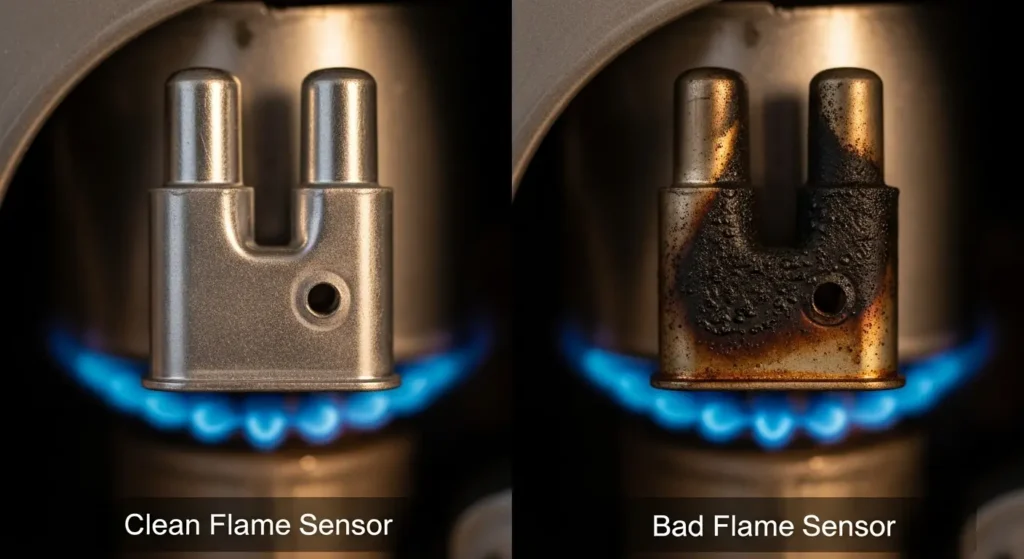
In tankless gas water heater maintenance, combustion health is critical. The burner assembly must maintain clean, stable flame patterns. Over time, carbon deposits can accumulate on burner ports.
Carbon buildup disrupts combustion efficiency. Flames may burn unevenly or produce incomplete combustion. That leads to:
- Reduced heating output
- Increased gas consumption
- Soot formation
- Error codes related to ignition
If carbon buildup continues unchecked, the burner assembly may require replacement. Professional combustion inspection during scheduled service prevents this type of failure.
Venting Restriction
Tankless gas systems rely on proper venting to exhaust combustion gases safely. Condensing models also produce moisture that must drain correctly.
Venting restriction can occur due to:
- Ice buildup in winter
- Improper slope in the vent pipe
- Blocked exterior termination
- Loose or disconnected joints
When airflow through the vent system is restricted, the pressure switch may shut the unit down. Repeated shutdown cycles stress internal components and may trigger persistent error codes.
Proper vent inspection is part of responsible tankless heater maintenance. In colder Mississauga winters, this check is especially important.
Condensate Drain Blockage
High-efficiency condensing tankless systems produce acidic condensate as a byproduct of combustion. That condensate must drain through a dedicated line.
If the condensate trap becomes clogged, moisture can back up into the unit. This may lead to corrosion, sensor faults, or automatic shutdown.
Condensate drain blockage is rarely noticed until the system stops producing hot water. Preventative cleaning avoids unexpected failure and protects internal electronics.
Sensor and Flow Meter Failure
Tankless systems rely heavily on sensors. Flow sensors detect water demand. Temperature sensors regulate outlet heat. Flame rods confirm ignition. Pressure switches verify venting.
Mineral debris, corrosion, and scale can interfere with sensor accuracy. When sensors misread data, the control board may trigger shutdowns or produce unstable temperature output.
Flow meter failure often causes inconsistent hot water delivery. Without proper tankless water maintenance, sensor replacement becomes common as the unit ages.
Ignored Error Codes
Modern tankless water heaters display diagnostic error codes. These codes are early warning signs. They may indicate scale buildup, venting restriction, ignition faults, or sensor problems.
Ignoring error codes allows small issues to grow. A minor descaling need today can become a heat exchanger failure later. Addressing error codes early during routine service prevents major breakdowns.
Many homeowners reset their unit without investigating the cause. That short-term solution often leads to repeated shutdowns.
Why These Failures Are Preventable With Our Tankless Water Heater Maintenance Checklist
Every issue listed above connects back to skipped maintenance. Tankless water heater maintenance is not complicated, but it must be consistent. Annual flushing, filter cleaning, vent inspection, combustion testing, and condensate checks keep internal components healthy.
In hard water areas like Mississauga, descaling intervals may need adjustment depending on mineral concentration. Ignoring maintenance increases energy use, reduces GPM flow rate, and shortens system lifespan.
Preventive service protects efficiency, stabilises temperature delivery, and preserves warranty coverage. A small investment in annual maintenance prevents expensive emergency repairs and early replacement.
When maintained properly, a tankless system delivers reliable hot water for many years. When neglected, internal damage begins quietly and accelerates quickly.
Tankless Water Heater Maintenance Checklist for Mississauga Homes
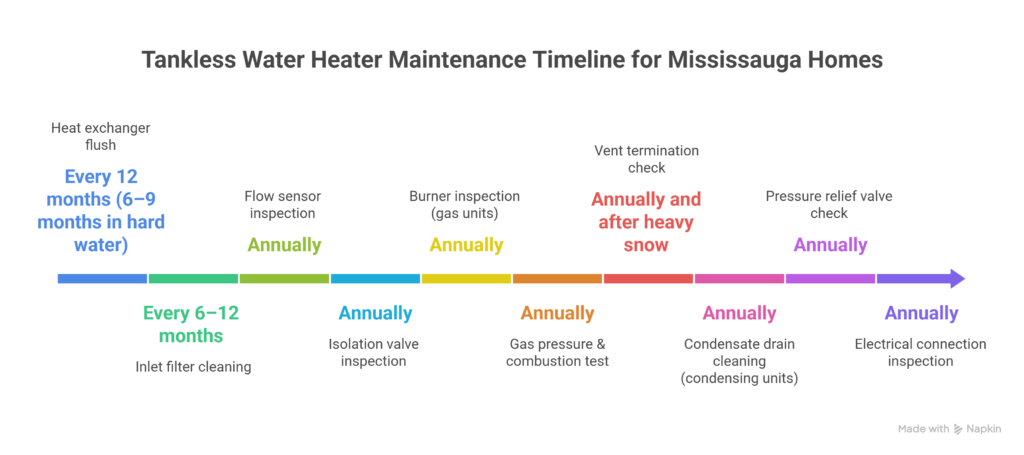
A real tankless water heater maintenance checklist goes far beyond a quick vinegar flush. In Mississauga, hard water mineral content accelerates calcium scale buildup inside the heat exchanger. That affects heat transfer efficiency, reduces GPM flow rate, stresses combustion components, and shortens system lifespan.
Tankless systems rely on narrow water channels, sensors, combustion stability, and venting performance. When maintenance is skipped, small restrictions quickly turn into overheating, error codes, or internal damage.
Below is a complete professional-grade tankless water heater maintenance checklist designed specifically for Ontario homes.
Complete Tankless Maintenance Checklist
| Task | Frequency | DIY or Pro | Why It Matters |
| Heat exchanger flush | Every 12 months (6–9 months in hard water) | Pro recommended | Removes mineral scale and restores heat transfer |
| Inlet filter cleaning | Every 6–12 months | DIY | Maintains proper water flow and GPM output |
| Flow sensor inspection | Annually | Pro | Prevents temperature fluctuation and flow errors |
| Isolation valve inspection | Annually | Pro preferred | Ensures safe flushing and prevents leaks |
| Burner inspection (gas units) | Annually | Pro only | Maintains clean combustion and efficiency |
| Gas pressure & combustion test | Annually | Pro only | Confirms safe flame and exhaust output |
| Vent termination check | Annually and after heavy snow | DIY visual / Pro inspection | Prevents exhaust restriction |
| Condensate drain cleaning | Annually | Pro recommended | Prevents moisture backup and corrosion |
| Pressure relief valve check | Annually | Pro preferred | Protects against unsafe pressure buildup |
| Electrical connection inspection | Annually | Pro | Annually, and after heavy snow |
| Recirculation system check (if installed) | Annually | Pro | Maintains instant hot water delivery |
| Error code scan & diagnostic review | During service | Pro recommended | Identifies early performance issues |
Heat Exchanger Flush
The heat exchanger is the most critical component in any tankless water heater. In Mississauga, hard water causes calcium and magnesium deposits to attach to internal copper or stainless steel surfaces.
Without annual descaling:
- Heat transfer efficiency drops
- Burners run longer
- Energy consumption increases
- Internal temperatures rise
- Metal fatigue develops
A professional tankless heater flush circulates approved descaling solution through service ports using isolation valves.
Good result: Restored efficiency, stable temperature, normal flow rate.
Bad result if skipped: Cracked heat exchanger and costly replacement.
Inlet Filter Cleaning
The cold water inlet screen protects the heat exchanger from debris and sediment.
When clogged:
- Flow rate decreases
- Temperature fluctuates
- Error codes may trigger
- The unit may shut down mid-use
Cleaning the filter is simple but critical for instant water heater maintenance.
Good result: Smooth flow and consistent hot water.
Bad result if skipped: Reduced GPM and unstable output.
Flow Sensor Inspection
The flow sensor measures incoming water demand. If mineral buildup interferes with its accuracy, the unit miscalculates heating load.
Symptoms of flow sensor issues include:
- Sudden cold bursts
- Temperature swings
- Delayed ignition
Professional inspection ensures stable temperature regulation.
Good result: Accurate heating response.
Bad result if skipped: Erratic performance and premature wear.
Burner Inspection and Combustion Testing (Gas Units)
For tankless gas water heater maintenance, combustion stability is essential.
Inspection includes:
- Burner port cleaning
- Flame pattern verification
- Carbon buildup removal
- Gas pressure measurement
- CO level testing
Poor combustion reduces efficiency and increases safety risks.
Good result: Clean flame and optimised gas use.
Bad result if skipped: Soot buildup, ignition failure, shutdown cycles.
Vent Termination and Pressure Switch Check
Gas units require proper venting to exhaust combustion gases. In Mississauga winters, snow and ice can block vent terminations.
Restricted venting may:
- Trigger pressure switch shutdown
- Cause repeated cycling
- Reduce combustion efficiency
Visual inspection and slope verification protect safe operation.
Good result: Reliable exhaust flow.
Bad result if skipped: Unexpected shutdown and possible safety hazard.
Condensate Drain Cleaning (Condensing Units)
High-efficiency tankless systems produce acidic condensate. This moisture must drain properly.
If clogged:
- Internal corrosion increases
- Sensor errors occur
- Water may back up into the unit
Cleaning the condensate trap prevents long-term damage.
Good result: Dry internal components and corrosion control.
Bad result if skipped: Moisture damage and electronic failure.
Pressure Relief Valve and Water Pressure Verification
The pressure relief valve protects the system from excessive internal pressure.
Maintenance includes:
- Valve seating inspection
- Discharge pipe verification
- Incoming water pressure testing
High municipal pressure in Ontario can strain internal seals.
Good result: Pressure safety and leak prevention.
Bad result if skipped: Risk of valve failure or internal damage.
Electrical Connection and Control Board Inspection
Loose terminals or corroded wiring can cause:
- Ignition faults
- Intermittent shutdown
- Error code recurrence
Electric tankless water heater maintenance also requires amperage verification and breaker stability checks.
Good result: Stable ignition and control reliability.
Bad result if skipped: Control board failure.
Recirculation System Maintenance (If Installed)
Homes with recirculation loops require additional checks:
- Pump operation
- Check valve function
- Loop flow verification
If neglected, recirculation systems reduce efficiency and may shorten heater lifespan.
Error Code Diagnostic Review
Modern tankless systems store diagnostic history. Reviewing error codes during service allows early correction before a major breakdown.
Ignoring codes leads to escalating failure.
Tankless water heater maintenance checklist in Mississauga must reflect local conditions. This is not a generic service routine.
Our municipal water contains moderate to high mineral content. That means calcium scale forms faster inside the heat exchanger compared to softer water regions. Even light mineral accumulation reduces heat transfer efficiency and forces longer burner run time.
Cold weather also plays a role. During the winter months, tankless systems work harder to raise the incoming water temperature. Groundwater entering the unit is significantly colder.
That increases heating demand and combustion duration in gas models. Longer heating cycles combined with mineral buildup accelerate internal stress.
High seasonal demand adds another factor. In busy households, especially during winter, tankless systems may operate continuously in the morning and evening. Without proper flushing and inspection, small restrictions quickly turn into performance problems.
A structured tankless maintenance checklist protects:
- Heat transfer efficiency so that burners or elements do not overwork
- Stable GPM output for consistent shower performance
- Proper combustion and venting safety in gas units
- Manufacturer warranty compliance
- Long-term lifespan of 15 to 20 years
When maintenance is skipped, energy consumption rises gradually. Burners run longer. Electric elements draw more power. Water flow becomes unstable. Error codes begin appearing. Over time, internal damage develops quietly until failure occurs.
Preventative maintenance keeps tankless hot water maintenance organised and predictable.
It avoids emergency breakdowns during peak winter demand. In hard water regions like Mississauga, annual service is not optional. It is the difference between steady hot water for years and premature system replacement.
If this tankless water heater maintenance checklist is now clear to you, let’s learn some related information to get the maximum benefits.
Also Read How to Clean a Hot Water Heater.
How Often Should You Flush a Tankless Water Heater in Ontario?
If you are searching for how often to flush a tankless water heater in Ontario, you are likely trying to avoid scale damage before it becomes expensive. The honest answer is this: the correct flush interval depends on water hardness, usage demand, and manufacturer requirements.
But in Mississauga, where mineral content is moderate to high, waiting too long between flushes is one of the fastest ways to reduce efficiency and shorten system lifespan.
Tankless water heater maintenance is not guesswork. It is preventative planning. Flushing removes calcium and magnesium deposits before they harden inside the heat exchanger. Once scale bonds to metal surfaces, heat transfer efficiency drops, burner run time increases, and energy bills quietly rise.
Below is how professionals determine the correct service interval.
1) Annual Baseline for Most Ontario Homes
For most Ontario households, the safe starting point is once per year.
Manufacturers of tankless gas water heater maintenance systems typically require annual flushing as part of warranty compliance. Even if your hot water feels normal, internal scale can still be forming.
Annual flushing:
- Restores heat transfer efficiency
- Prevents early heat exchanger wear
- Maintains stable outlet temperature
- Keeps error codes from developing
Think of it as resetting internal performance before visible symptoms appear.
2) Hard Water Adjustment in Mississauga
Mississauga water contains dissolved minerals that accelerate scale formation. When water is rapidly heated inside a tankless unit, minerals separate and attach to the heat exchanger.
If your home does not have a water softener, annual flushing may not be enough. In many local households, a 6 to 9 month interval is more realistic.
Why the adjustment?
Because mineral precipitation increases with temperature. Tankless systems heat water instantly and aggressively. That makes them more sensitive to scale compared to traditional tank heaters.
Homes with higher usage, large families, or multiple daily showers often require shorter service intervals.
3) How Water Hardness Directly Impacts Flush Frequency
Water hardness affects three key internal factors:
- Scale accumulation speed
- Flow restriction rate
- Efficiency decline curve
As scale thickens inside narrow heat exchanger passages:
- Internal diameter reduces
- GPM output drops
- Burner run time increases
- Metal surfaces overheat
When internal temperatures rise beyond normal operating range, component stress increases. That is when premature failure begins.
The goal of tankless maintenance is to flush before hardened deposits form thick layers.
4) Signs Scale Is Already Forming
You do not need to open the unit to know maintenance is overdue. Performance clues appear first.
Watch for:
- Temperature fluctuation during showers
- Reduced hot water pressure
- Longer time to reach the set temperature
- Slight rumbling noise during operation
- Minor error codes that reset but return
These are early warnings of mineral buildup inside the heat exchanger.
If you notice these symptoms, do not wait until the annual mark. Schedule flushing immediately.
5) Practical Service Interval Guidance
Here is a realistic Ontario guideline:
- Moderate water hardness + average household → Flush every 12 months
- Moderate to hard water + higher usage → Flush every 9 months
- Hard water + no softener + heavy demand → Flush every 6 to 9 months
- Visible symptoms present → Flush now
Preventative flushing always costs less than heat exchanger replacement. If unsure about your specific condition, a professional tankless water heater maintenance checklist evaluation can determine the proper interval.
In Ontario, flushing once per year is the minimum standard. In Mississauga, mineral conditions often justify shorter intervals. Waiting until performance drops means scale has already reduced efficiency.
Proactive scheduling protects heat transfer efficiency, stabilises GPM flow rate, preserves warranty compliance, and supports a full 15 to 20 year lifespan.
The earlier the scale is removed, the easier and safer the maintenance process becomes.
How Does Water Hardness in Mississauga Affect Maintenance Frequency?
Water hardness is not a small factor. It is the primary driver of tankless water heater maintenance frequency in Mississauga homes.
To understand why, you need to understand the internal process step by step.
Step 1: Mineral Content Enters the Heat Exchanger
Mississauga municipal water carries dissolved calcium and magnesium. These minerals are harmless to drink but aggressive when exposed to high heat.
When cold water enters the tankless unit, it travels through narrow copper or stainless steel channels.
Step 2: Rapid Heating Forces Mineral Separation
Tankless systems raise water temperature almost instantly. That rapid heating forces dissolved minerals to separate and bond to hot metal surfaces.
This is where scale begins.
The hotter the surface, the faster minerals attach.
Step 3: Scale Accumulation Rate Increases Over Time
Scale does not build evenly. Once the first layer forms, it creates a rough surface. That roughness attracts additional mineral deposits.
This accelerates the scale accumulation rate.
What starts as a thin layer becomes thicker and harder over months of operation.
Step 4: Flow Restriction and Efficiency Loss Develop
As scale thickens:
- Water flow narrows
- GPM output declines
- Burner run time increases
- Efficiency drops
The unit compensates by operating longer to meet temperature demand. That increases fuel consumption and internal wear.
This is why hard water directly shortens maintenance intervals.
Step 5: Descaling Frequency Must Be Adjusted Accordingly
Because mineral buildup compounds over time, descaling frequency must reflect local hardness levels.
In Mississauga homes without water softeners, annual flushing may not be enough to prevent efficiency decline.
Adjusting maintenance to 6 to 9 month intervals prevents hardened deposits from bonding permanently.
Step 6: When to Consider a Water Softener
If flushing becomes necessary twice per year or more, a water softener may reduce long-term maintenance costs.
A properly functioning softener:
- Reduces calcium precipitation
- Slows scale formation
- Extends flush intervals
- Protects plumbing fixtures
- Improves long-term system efficiency
For high mineral zones, softening water protects not just the tankless unit, but the entire plumbing system.
Water hardness determines how fast scale forms, how quickly flow becomes restricted, and how soon efficiency begins to decline.
In Mississauga, mineral content makes proactive tankless water maintenance essential. Shorter intervals protect heat exchanger integrity, stabilise hot water delivery, and preserve system lifespan.
Ignoring local water conditions is one of the most common reasons tankless systems fail early.
Maintenance timing should match mineral reality, not just calendar reminders.
What Tankless Water Heater Maintenance Mistakes Should You Avoid?
Tankless systems are durable, but they are not forgiving. Many failures we see in Mississauga homes are not from old age. They are from small maintenance mistakes that compound over time.
Avoiding these errors protects heat transfer efficiency, combustion safety, and long-term reliability. Here are the most common tankless water heater maintenance mistakes that lead to premature breakdown.
Using the Wrong Descaling Chemicals
Not all descaling solutions are safe for tankless heat exchangers.
Some homeowners use harsh chemical cleaners designed for industrial equipment. Others mix unknown solutions. Aggressive chemicals can damage copper or stainless steel surfaces and weaken internal seals.
Approved descaling solutions or food-grade white vinegar are typically recommended. Using the wrong product may:
- Corrode internal components
- Damage isolation valve seals
- Void the manufacturer’s warranty
The goal is mineral removal, not metal damage.
Skipping the Annual Flush
This is the most common mistake in Mississauga.
Because tankless systems provide continuous hot water, homeowners assume everything is fine. But scale builds quietly. You do not see it forming.
Skipping annual tankless heater flush service allows mineral deposits to harden. Hardened scale becomes more difficult to remove and increases heat exchanger stress.
Consequences of skipping annual flushing:
Higher gas or electric consumption
- Reduced GPM flow rate
- Overheating shutdown
- Shortened lifespan
Preventative flushing always costs less than heat exchanger replacement.
Ignoring Error Codes
Modern tankless water heaters display diagnostic codes for a reason. They are early warning signs.
Common causes behind recurring codes include:
- Flow sensor obstruction
- Venting restriction
- Ignition instability
- Overheat protection activation
Resetting the unit without addressing the cause allows internal damage to continue. Error codes should never be ignored during tankless water heater maintenance.
Small alerts today often prevent expensive repairs tomorrow.
Over-Tightening Service Valves
During DIY maintenance, some homeowners over-tighten isolation valves or service ports.
Over-tightening can:
- Crack valve bodies
- Damage threads
- Distort rubber seals
- Create slow leaks
Tankless components are precision parts. Excess force causes long-term issues. Valves should be snug, not forced.
Running the Unit Dry After Maintenance
After a flush, the unit must be properly refilled and purged of air before restoring power.
Running a tankless water heater dry, even briefly, can:
- Overheat heating elements
- Damage the heat exchanger
- Trigger high limit safety shutdown
Always confirm water flow is fully restored before turning the unit back on.
Not Reinstalling Filters Correctly
Inlet filter screens are small but critical. If installed backwards or loosely, debris can enter the heat exchanger.
A misaligned filter may:
- Restrict flow
- Trigger temperature fluctuation
- Cause error codes
Tankless maintenance is not only about flushing. Small components matter.
Why These Mistakes Matter
Tankless water heater maintenance is precise. Small shortcuts create large problems over time.
Avoiding these common errors protects:
- Stable outlet temperature
- Efficient combustion
- Heat exchanger integrity
- Warranty compliance
- 15 to 20-year lifespan
In Mississauga’s hard water conditions, disciplined maintenance makes the difference between smooth operation and repeated service calls.
How Much Does Tankless Water Heater Maintenance Cost in Mississauga?
Cost is one of the first concerns homeowners have. The good news is that preventative maintenance is far more affordable than reactive repair.
Tankless water heater maintenance cost in Mississauga depends on the type of service, system condition, and whether parts are required.
Below is a realistic breakdown.
Typical Tankless Maintenance Cost in Mississauga
| Service Type | Estimated Cost Range |
| Basic flush | $150 – $250 |
| Full tune up (flush + inspection) | $250 – $400 |
| Full tune-up (flush + inspection) | $300 – $500 |
| Emergency service call | $350 – $700+ |
| Full system replacement | $4,000 – $8,000+ |
Basic Flush
A basic tankless heater flush includes circulating descaling solution through the heat exchanger using service ports.
This restores efficiency and removes scale buildup.
It is the minimum yearly requirement for tankless water heater maintenance.
Full Tune Up
A complete tankless water heater tune-up includes:
- Heat exchanger flush
- Inlet filter cleaning
- Burner inspection (gas units)
- Venting check
- Condensate drain inspection
- Error code scan
This comprehensive service protects both performance and warranty compliance.
Descaling With Minor Parts Replacement
Sometimes flushing reveals worn seals, clogged filters, or minor component wear.
Replacing small parts during service prevents larger failures later.
Emergency Service
If maintenance has been skipped and the unit shuts down unexpectedly, emergency service costs increase.
Urgent repairs may involve:
- Scale removal
- Sensor replacement
- Ignition troubleshooting
- Pressure switch correction
Emergency rates are higher, especially during winter demand.
Comparing Maintenance to Replacement Cost
Replacing a tankless water heater in Mississauga can cost $4,000 to $8,000 or more, depending on venting configuration and gas line requirements.
Compared to that, annual tankless maintenance is minimal.
Preventative service:
- Protects the heat exchanger’s lifespan
- Maintains energy efficiency
- Reduces the risk of an emergency breakdown
- Preserves the manufacturer’s warranty
Skipping $250–$400 per year can eventually lead to thousands in replacement cost.
Tankless water heater maintenance is predictable and affordable. Repairs from neglect are unpredictable and expensive.
In Mississauga, where mineral buildup accelerates internal wear, routine service protects both performance and long-term financial investment.
Preventative care is not just maintenance. It is cost control.
Here is a guide on Navien Installation Costs & Warranty.
What Warning Signs Mean Your Tankless Water Heater Needs Immediate Service?
Tankless water heaters rarely fail without warning. Most systems show subtle performance changes before a full shutdown occurs. The key is recognising these signals early. In Mississauga, where hard water mineral buildup accelerates internal wear, ignoring early symptoms can quickly lead to heat exchanger damage or combustion instability.
Below are the warning signs that mean your tankless water heater maintenance is no longer routine; it is urgent.
1) Temperature Fluctuation During Use
If your shower suddenly alternates between hot and lukewarm, that is not random.
Temperature fluctuation usually indicates:
- Scale buildup is restricting heat transfer
- Flow sensor misreading demand
- Burner instability in gas units
- Mineral obstruction affecting internal passages
When scale coats the heat exchanger, the system struggles to maintain a stable outlet temperature. The burner cycles harder, and the water temperature becomes inconsistent.
If hot water cannot remain steady under normal demand, service should not be delayed.
2) Low Hot Water Flow
Reduced hot water pressure is one of the earliest signs of mineral restriction.
Possible causes include:
- Clogged inlet filter screen
- Scale narrowing internal water pathways
- Flow sensor obstruction
When GPM output drops, the system compensates by running longer. That increases internal temperature stress.
Low flow is not just a comfort issue. It is an efficiency and longevity issue.
3) Recurring Error Codes
Modern tankless systems display error codes for specific faults.
Common triggers include:
- Ignition failure
- Venting restriction
- Overheat protection activation
- Combustion imbalance
If you reset the unit and the same code returns, that means the root cause remains unresolved.
Recurring error codes indicate internal strain. Ignoring them increases repair costs over time.
4) Loud Rumbling or Popping Sounds
A properly maintained tankless water heater runs quietly.
Rumbling or popping sounds often mean:
- Hardened mineral scale overheating
- Water flashing into steam inside the scaled passages
- Internal heat stress
These noises are a sign that descaling is overdue. Continued operation under these conditions increases the risk of heat exchanger damage.
5) Longer Heating Time
If hot water takes longer than usual to reach the desired temperature, internal efficiency may have dropped.
Scale buildup reduces heat transfer speed. Burners must run longer to compensate. Electric units draw more amperage for extended periods.
This slow decline often goes unnoticed until energy bills increase.
6) Visible Leaks
Any moisture around the unit should be taken seriously.
Leaks may indicate:
- Worn isolation valve seals
- Pressure relief valve issues
- Internal corrosion
- Condensate drain blockage
Water exposure inside the cabinet can damage electronic control boards quickly.
When Immediate Service Is Necessary
Seek professional service immediately if you notice:
- Persistent error codes
- Sudden loss of hot water
- Strong combustion smell
- Repeated shutdown during use
- Visible corrosion or water pooling
Prompt action protects heat exchanger integrity and prevents full system replacement.
In Mississauga’s hard water conditions, waiting even a few weeks after symptoms appear can significantly increase repair costs.
Why Should You Choose HVAC Group for Tankless Water Heater Maintenance in Mississauga?
Tankless systems require precision. They are not standard tank heaters. Combustion balance, flow regulation, and scale management must be handled correctly to protect long-term performance.
At HVAC Group, we specialise in tankless water heater maintenance for Mississauga homes. We understand local water hardness levels, seasonal heating demand, and gas safety regulations in Ontario.
Each manufacturer has specific maintenance requirements. We follow them precisely to protect warranty coverage.
What Sets Our Maintenance Service Apart
- Full combustion testing with proper analyser equipment
- Professional-grade descaling pumps and approved solutions
- Accurate gas pressure verification
- Venting slope and termination inspection
- Hard water scale assessment specific to Mississauga conditions
- Gas safety compliant servicing
- Warranty safe maintenance documentation
- Transparent pricing with no hidden charges
- Same-day service availability during peak seasons
We do not perform surface-level flushing. We conduct structured inspections designed to protect your system long term.
Why Professional Maintenance Protects Your Investment
Routine service from experienced technicians protects:
- 15 to 20-year system lifespan
- Stable GPM flow rate
- Heat transfer efficiency
- Safe combustion performance
- Warranty eligibility
Preventative maintenance avoids emergency breakdown during winter demand. It keeps hot water consistent and predictable.
Our goal is simple: reliable hot water without stress, surprise repair costs, or efficiency loss.
If your system is due for tankless maintenance in Mississauga, booking service before performance drops is the smartest decision.
Learn Why Hire a Licensed HVAC Professional.
Final Thoughts
Tankless water heater maintenance checklist planning is not optional in Mississauga. Hard water mineral buildup, cold groundwater temperature, and seasonal demand all increase internal stress on your system.
An annual flush is the baseline. In many local homes, shorter intervals may be necessary. Skipping service allows scale to harden, efficiency to decline, and repair costs to rise quietly.
Preventative maintenance protects heat transfer efficiency, stable GPM output, and long-term system lifespan. It also preserves manufacturer warranty coverage.
If your tankless unit has not been serviced recently, now is the right time to schedule maintenance. Reliable hot water year-round starts with proactive care.