

Is your air conditioner running but not starting properly? Sometimes the problem comes down to a small electrical part called the AC capacitor. This component stores energy and gives the compressor and fan motor the boost they need to start the cooling cycle.
When this happens, many homeowners start searching how much does it cost to replace an AC capacitor.
The good news is that this repair is usually one of the more affordable AC fixes. In most cases, homeowners pay between $120 and $350, including the part and the technician’s labor.
In this guide, you’ll learn the typical replacement cost, common signs of a failing capacitor, what factors affect the price, and when it’s best to call an HVAC technician.
So, let’s first take a closer look at how this small part affects your air conditioner.
What an AC Capacitor Actually Does in Your Air Conditioning System?
An AC capacitor is a small electrical component located inside the outdoor condenser unit. Its job is simple but critical. It stores electrical energy and releases it when the system needs an extra boost to start important motors.
When your thermostat calls for cooling, several components must start almost at the same time. The compressor begins circulating refrigerant, and the condenser fan motor starts pulling air through the outdoor unit. Both motors need a quick burst of power to start spinning. That starting boost comes from the capacitor.
Most residential air conditioners use one of the following types:
- Start capacitor: Provides a strong burst of energy to start the compressor
- Run capacitor: Helps motors continue running efficiently
- Dual run capacitor: Powers both the compressor and condenser fan motor
Here is the simplified startup sequence inside your AC system:
- The thermostat signals the system to begin cooling
- Then, the electrical circuit activates the outdoor condenser unit
- The capacitor releases stored energy to start the motors
- The compressor begins moving refrigerant through the system
- The condenser fan motor pulls air across the coils to release heat
When the capacitor weakens or fails, this sequence cannot start correctly. The compressor or fan motor may struggle to start, run slowly, or stop completely. Homeowners often notice symptoms such as the outdoor unit humming, the fan not spinning, or the system taking longer to start.
In places like Mississauga, air conditioners often run for long periods during hot and humid summer days. Frequent starting cycles and heat exposure can place extra stress on capacitors, which is one reason they commonly fail after several years of operation.
What Happens When an AC Capacitor Stops Working?
When homeowners search how much does it cost to replace an AC capacitor, the air conditioner has usually already stopped starting properly. In most cases, the problem appears during the startup sequence of the outdoor condenser unit.
Here is what normally happens inside the system.
When the thermostat calls for cooling, electrical power flows to the condenser unit. The capacitor releases stored electrical energy that helps start the compressor and the condenser fan motor. This short burst of energy gives both motors the starting torque required to begin the cooling cycle.
When the capacitor fails, that startup boost disappears. The system still receives power, but the motors struggle to start or fail to start completely.
This often leads to several observable symptoms:
- The outdoor unit hums, but the fan does not spin
- Then, the compressor struggles to start or shuts off quickly
- The air conditioner takes longer than usual to begin cooling
- Warm air continues blowing through the vents
In many homes, these symptoms appear at the same time as problems where the system is ac working but not cooling properly. Electrical component wear, airflow restrictions, and poor seasonal maintenance can also contribute to similar cooling issues often seen during air conditioner tune-up inspections.
During hot and humid summers in Mississauga, air conditioners may start and stop many times throughout the day. These repeated cycles place stress on electrical components like capacitors.
Over time, the stored charge weakens, and once the capacitor can no longer provide the starting boost, the AC system will not start its cooling cycle.
AC Capacitor Replacement Cost: What Homeowners Usually Pay
If your technician has confirmed a failed capacitor, the next question is obvious: how much does it cost to replace an AC capacitor?
In most residential air conditioners, this repair is relatively inexpensive. The capacitor itself is a small electrical component inside the outdoor condenser unit. Replacing it is usually quick, but the total price often includes the service visit, system inspection, and installation.
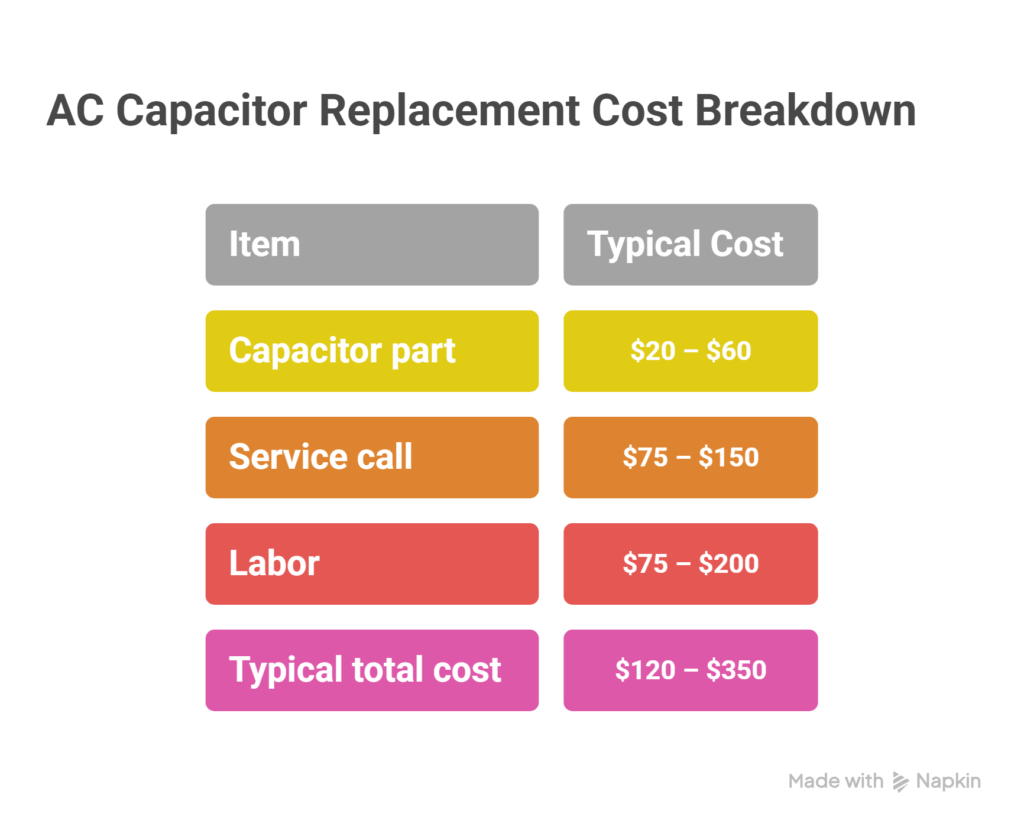
Most homeowners typically pay between $120 and $350 for AC capacitor replacement.
Here is a typical breakdown of the costs involved.
| Item | Typical Cost |
| Capacitor part | $20 – $60 |
| Service call | $75 – $150 |
| Labor | $75 – $200 |
| Typical total cost | $120 – $350 |
The capacitor itself is rarely the expensive part. What homeowners usually pay for is the technician’s time to diagnose the system, confirm the failure, and install the replacement safely.
AC Capacitor Part Cost
The capacitor used in most residential air conditioners is relatively inexpensive. These components are designed to provide the electrical boost needed to start the compressor and the condenser fan motor.
Two types are commonly used in residential systems:
- Run capacitors, which support a single motor
- Dual run capacitors, which power both the compressor and the condenser fan
Typical capacitor prices fall between $20 and $60, depending on the required microfarad rating and voltage capacity. Larger condenser units sometimes use higher-rated capacitors, which may cost slightly more.
HVAC Service Call Cost
Before replacing any electrical component, an HVAC technician must confirm the exact cause of the problem. This is why most companies charge a service call or diagnostic fee.
During this visit, the technician will usually:
- Inspect the outdoor condenser unit
- Test the capacitor with a multimeter
- Check the compressor and condenser fan motor
- Verify that the contactor and wiring are functioning properly
Service calls generally range from $75 to $150, depending on the company and travel distance.
Labor Cost for Capacitor Replacement
Once the failed capacitor is identified, the actual replacement is relatively quick. The technician disconnects power to the condenser unit, safely discharges the old capacitor, and installs a new component with the correct wiring configuration.
In most cases, this process takes 15 to 30 minutes.
Labor charges typically range from $75 to $200, depending on system accessibility and service scheduling.
Across Mississauga and the GTA, prices can increase slightly during peak summer heat when emergency cooling repairs become more common.
Many capacitor failures are discovered during seasonal inspections. Understand the benefits of regular HVAC maintenance to help yourself avoid unexpected capacitor failures.
Why AC Capacitor Replacement Costs Can Vary?
Earlier, we looked at the typical price range. In practice, the final repair cost can shift a little. That usually depends on the type of capacitor in the system, how the condenser unit is built, and how much diagnostic work the technician needs to do.
A capacitor itself is a small part. The time required to diagnose and install it is what changes the total bill.
Type of Capacitor Used in the System
Air conditioners generally use either a single-run capacitor or a dual-run capacitor.
A single run capacitor supports one motor. Most often, it helps the condenser fan motor run smoothly. A dual run capacitor is slightly different. It supports both the compressor and the condenser fan motor at the same time.
Dual run capacitors are common in modern central air conditioners. They combine two electrical functions into one component, which means the rating must match the system exactly. The technician has to check the microfarad rating and voltage printed on the old capacitor before installing a replacement.
Because of that, dual run capacitors usually cost a little more than single run capacitors.
Air Conditioner Brand and System Design
Not every condenser unit is laid out the same way. Different manufacturers place electrical components in different parts of the unit.
Some systems leave plenty of room inside the service panel. Others pack the contactor, capacitor, and wiring tightly together. When components are crowded, it simply takes longer to disconnect wiring and install the replacement safely.
The capacitor also needs to match the electrical specification required by the manufacturer. Using the wrong rating can cause the compressor or fan motor to struggle during startup.
Labor and Diagnostic Time
A good technician does not replace electrical parts blindly. The system needs to be tested first.
That diagnostic time is usually part of the service call.
Emergency or After-Hours Repairs
Air conditioners tend to fail during the hottest days of summer. That is also when HVAC companies are busiest.
If the repair happens during evenings, weekends, or extreme heat waves, service rates may be slightly higher. Emergency visits often move a technician ahead of the normal schedule, which increases the total repair cost.
Can You Replace an AC Capacitor Yourself?
Some homeowners think about replacing the capacitor themselves because the part is inexpensive. On the surface, it looks simple. In reality, there are a few risks involved.
An AC capacitor stores electrical energy. Even after the power to the unit is turned off, the capacitor can still hold a charge. If it is not discharged properly, touching the terminals can cause a strong electrical shock.
There is also the wiring to consider. The capacitor connects directly to the compressor and condenser fan motor. Mixing up those wires can prevent the system from starting, or in some cases, damage the compressor.
Another common issue is installing the wrong capacitor. Each unit requires a specific microfarad rating and voltage rating. If the replacement capacitor does not match those numbers, the motors may not start correctly, and the component can fail again quickly.
For these reasons, many homeowners prefer to have a technician handle the replacement. The technician can confirm the failed capacitor, match the correct electrical rating, and install the new component safely inside the condenser unit.
Also read: How to prepare your air conditioner for Summer.
How to Prevent AC Capacitor Failure and Extend System Life
AC capacitors fail mostly because of heat, electrical stress, and aging components. While no electrical part lasts forever, proper system maintenance can significantly reduce the chances of sudden capacitor failure.
A well-maintained air conditioning system places less strain on electrical components, which helps the capacitor operate within its designed voltage and microfarad rating.
Below are a few practical maintenance steps technicians recommend.
Regular AC Maintenance
Seasonal inspections allow technicians to test electrical components before they fail. During routine maintenance, technicians measure the microfarad rating of the capacitor and inspect the compressor circuit, contactor, and wiring connections.
Identifying weak capacitors early prevents unexpected system shutdowns during peak cooling season.
Cleaning the Outdoor Condenser Unit
The capacitor sits inside the outdoor condenser unit, where it is exposed to heat generated by the compressor and condenser coil. When the unit becomes clogged with dust, leaves, or debris, airflow decreases, and the internal temperature rises.
Higher condenser unit temperature increases electrical stress on capacitors and other electrical components.
Keeping the condenser unit clean helps the system dissipate heat properly.
Protecting the System from Power Surges
Electrical surges from storms or unstable grid power can damage HVAC components. Installing surge protection or ensuring proper grounding helps stabilize voltage and protect the capacitor from sudden electrical spikes.
Replacing Aging Electrical Components
Capacitors gradually lose their ability to store charge as they age. When the microfarad rating drops below the manufacturer’s specification, the compressor and condenser fan motor may struggle to start.
Replacing weak capacitors during maintenance inspections helps prevent unexpected breakdowns.
Proper maintenance offers several benefits:
- better cooling performance
- longer compressor lifespan
- fewer emergency AC repairs
Here is a guide to avoid top HVAC mistakes.
AC Capacitor Replacement Service in Mississauga
By now, you have a clear idea of how much does it cost to replace an AC capacitor and why this small electrical component can stop an air conditioner from starting properly. In most cases, the repair itself is straightforward once the failed capacitor has been confirmed.
The key step is proper diagnosis. Capacitors work closely with the compressor circuit and condenser fan motor, so technicians must verify the electrical readings before installing a replacement. Matching the correct microfarad rating and voltage specification is essential to restore normal system operation.
That is where experienced HVAC technicians make the difference.
At HVAC Group, our team provides professional air conditioning diagnostics and repairs across Mississauga and the Greater Toronto Area. We inspect the condenser unit, test electrical components, and install the correct capacitor so the system can start and run safely again.
Learn more about our professional heating and cooling services at HVAC Group and see how our technicians help homeowners across Mississauga keep their HVAC systems running efficiently.