

When your AC is running but not cooling, it is easy to assume the whole system is done for. In many cases, one of the biggest concerns is AC Compressor Failure. This is especially true if the outdoor unit is making strange noises, struggling to start, or blowing warm air through the vents.
A bad AC compressor can turn a normal summer day into a sweaty mess in no time.
Still, not every AC not cooling problem means the compressor is finished. The real issue could be related to the refrigerant, airflow, or another failing part.
In this guide, we will break down the common symptoms, main causes, likely fixes, and AC compressor replacement cost so you can understand what is happening and what to do next.
For related warning signs, you can read about your air conditioner needing repair.
What Is an AC Compressor and What Does It Do?
An AC compressor is the component that drives refrigerant through the cooling cycle. It sits inside the outdoor condensing unit and works with the evaporator coil, condenser coil, metering device, suction line, and discharge line.
The compressor does not produce cold air on its own. Its job is to create the pressure conditions that allow the system to absorb heat indoors and release it outside.
Below is the common process of how an AC compressor usually works:
The process starts at the evaporator coil
When the thermostat calls for cooling, warm indoor air moves across the evaporator coil, and the refrigerant inside that coil absorbs heat from the air.
At that stage, the refrigerant leaves the indoor coil as a low-pressure vapour. That vapour then travels through the suction line toward the air conditioner compressor.
The AC compressor changes the refrigerant’s pressure and temperature
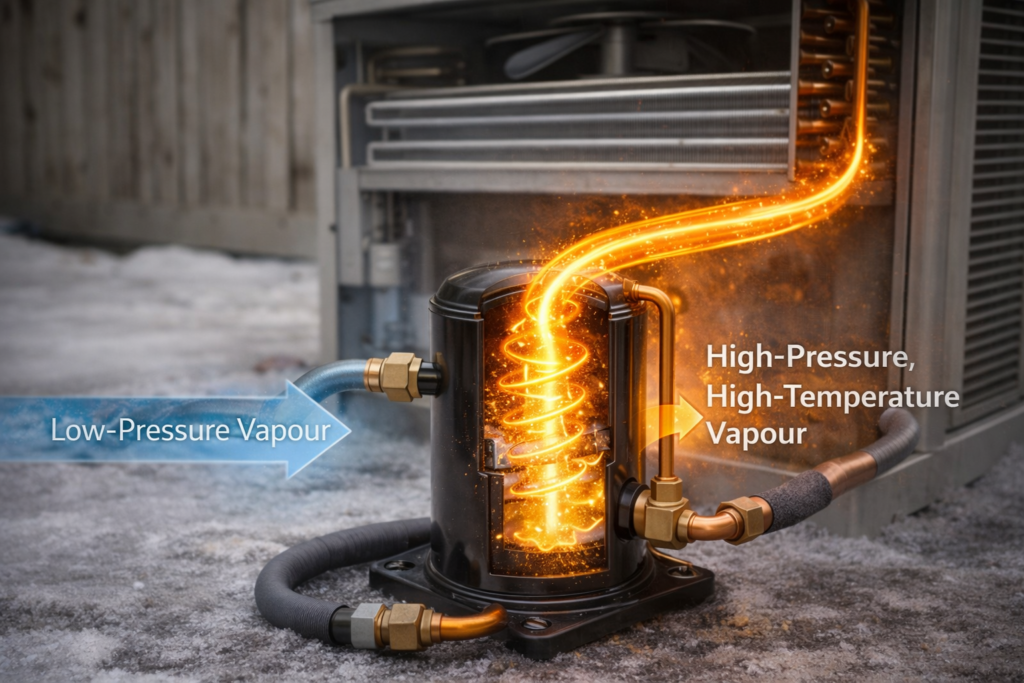
Once the refrigerant enters the AC compressor, the compressor squeezes that low-pressure vapour into a high-pressure, high-temperature vapour. This is the key mechanical step in the cycle.
The compressor creates the pressure differential that the system needs to keep refrigerant moving in the correct direction. Without that pressure change, the refrigerant cycle loses force, and cooling performance drops.
Compressor prepares the refrigerant for heat rejection
After compression, the refrigerant leaves through the discharge line and enters the condenser coil in the outdoor unit. At this stage, the refrigerant is hotter than the outdoor air. That condition matters.
Heat can only leave the refrigerant when the refrigerant temperature is high enough for the condenser coil to reject that heat to the outside air.
The condenser coil removes heat after compression
The outdoor fan pulls air across the condenser coil. As air moves over the coil, heat transfers out of the refrigerant. The refrigerant then starts to cool and move toward a liquid state.
From there, it continues through the refrigerant cycle, passes through the metering device, drops in pressure, and returns to the evaporator coil to absorb more indoor heat.
Compressor supports refrigerant flow, system balance, and cooling capacity
The HVAC compressor is not just pushing refrigerant around. It maintains the pressure relationship between the low side and high side of the system. That balance affects heat transfer, phase change, and overall cooling capacity. If the compressor cannot maintain the right suction pressure and discharge pressure, the system cannot move heat efficiently.
The result is often weak cooling, warm air from vents, longer run times, and rising energy use.
The compressor depends on the rest of the system doing its job
A compressor works under load. It depends on proper refrigerant charge, stable airflow, clean coils, and normal operating pressure. If airflow drops across the evaporator coil, the refrigerant may not return under the right conditions.
If the condenser coil is dirty, heat rejection suffers, and system pressure rises. If the refrigerant charge is low, the compressor can run under stress. In other words, compressor performance depends on full system balance, not on the compressor alone.
That is the basic role of the air conditioner compressor. It receives low-pressure refrigerant vapour, raises pressure and temperature, sends that refrigerant to the condenser coil, and keeps the full refrigerant cycle moving.
When it does its job properly, the system can remove indoor heat in a controlled way. When it does not, the entire cooling process starts to break down. In some cases, that leads homeowners to compare repair against larger system options, including AC installation services in Mississauga.
However, the process is much more complicated, to be honest. But why should all these things matter in the first place, right? Let’s find out those now.
Why AC Compressor Failure Is A Big Concern For Homeowners?
AC compressor failure changes more than one part’s operation. It disrupts refrigerant flow, pressure balance, heat rejection, and cooling capacity across the full system. A unit can still power on while the compressor loses pumping efficiency, runs hot, or works under abnormal load.
That partial operation often misleads homeowners into waiting, since the air conditioner has not reached a complete AC breakdown yet. Delay usually adds stress to the motor, windings, oil circulation, and discharge conditions.
The result is a wider repair scope, poorer comfort, higher energy use, and a chance of the air conditioner not cooling when demand peaks.
Capacity Loss
You can feel this problem pretty quickly. When the compressor cannot maintain normal refrigerant flow, your AC starts losing cooling output fast.
Air may still move across the evaporator coil, but the system no longer has the pressure difference it needs for proper heat absorption and phase change.
Once that happens, cooling efficiency drops, and the coil cannot pull heat out of your home the way it should. You will usually notice longer run times, warmer air from the vents, and an air conditioner that keeps running without cooling your space properly.
Power Waste
You may see this on your hydro bill before the AC fully breaks down. As the compressor weakens, runtime goes up while cooling output drops. The system keeps using power, but it moves less heat. That is why you get longer cycles, poorer comfort, and higher energy bills at the same time.
Pressure Shift
Once the compressor starts losing control of the system pressure, the whole cycle gets unstable. Low suction pressure can weaken evaporator performance. High discharge pressure can raise compressor load and stress the condenser side.
That pressure shift affects heat rejection, system balance, and cooling performance, which is why compressor trouble usually shows up through more than one symptom.
Heat Load
A struggling compressor builds heat fast. High discharge temperature puts extra stress on the motor, windings, and oil. If airflow is already restricted or the condenser coil is dirty, head pressure climbs even more. That is how a smaller operating issue can turn into a serious AC breakdown.
Damage Spread
Small system faults often end up hurting the compressor. Low refrigerant, poor airflow, dirty coils, or repeated short cycling can push pressure and temperature out of range.
The compressor then runs under heavier thermal and mechanical stress. That is why routine inspections matter, and why the long-term benefits of regular HVAC maintenance often show up in catching smaller issues before they shorten compressor life.
Comfort Drop
You often feel compressor trouble before the system fully stops. Cooling turns uneven, humidity starts building, and the house takes longer to reach the set temperature. The AC sounds active, but comfort keeps slipping.
Repair Growth
Delay usually makes the repair bigger. What starts as a refrigerant, airflow, or electrical issue can push more stress into the compressor. Once internal wear builds, labour goes up, testing gets deeper, and replacement becomes more likely.
System Strain
Compressor trouble rarely stays isolated. Longer runtime adds wear to capacitors, contactors, fan motors, and control components. Pressure swings also make heat rejection less efficient, which pushes the outdoor unit harder than it should.
That is how one fault starts stressing the rest of the system. This is also where avoidable upkeep problems start showing up, which is why homeowners should avoid the top HVAC mistakes.
Cost Exposure
Compressor problems get expensive because the repair has to be confirmed, not guessed. A proper call may involve pressure readings, electrical testing, airflow checks, refrigerant work, and compressor performance testing.
Once those checks confirm AC compressor failure, you are no longer dealing with a minor cooling issue. You are dealing with a repair that affects comfort, efficiency, reliability, and the value of the whole AC system.
However, the system can still run while cooling drops, energy use climbs, and internal stress keeps building. Once that pattern starts, the next question is usually cost. How much will the repair actually be, and when does replacement make more sense?
Let’s look at the AC compressor failure full fixes and what usually causes them.
AC Compressor Failure: Symptoms, Causes, and Fixes
If your AC is still running but your home is not cooling the way it should, you are probably trying to figure out one thing fast: is this really AC compressor failure, or is something else causing the problem?
That is where we need to slow the issue down and read the signs properly. Warm air, hard starts, loud noise, short cycling, and breaker trips do not all point to the same fault. Some signs suggest a weak compressor.
Others come from low refrigerant, airflow problems, or electrical issues that can damage the compressor over time.
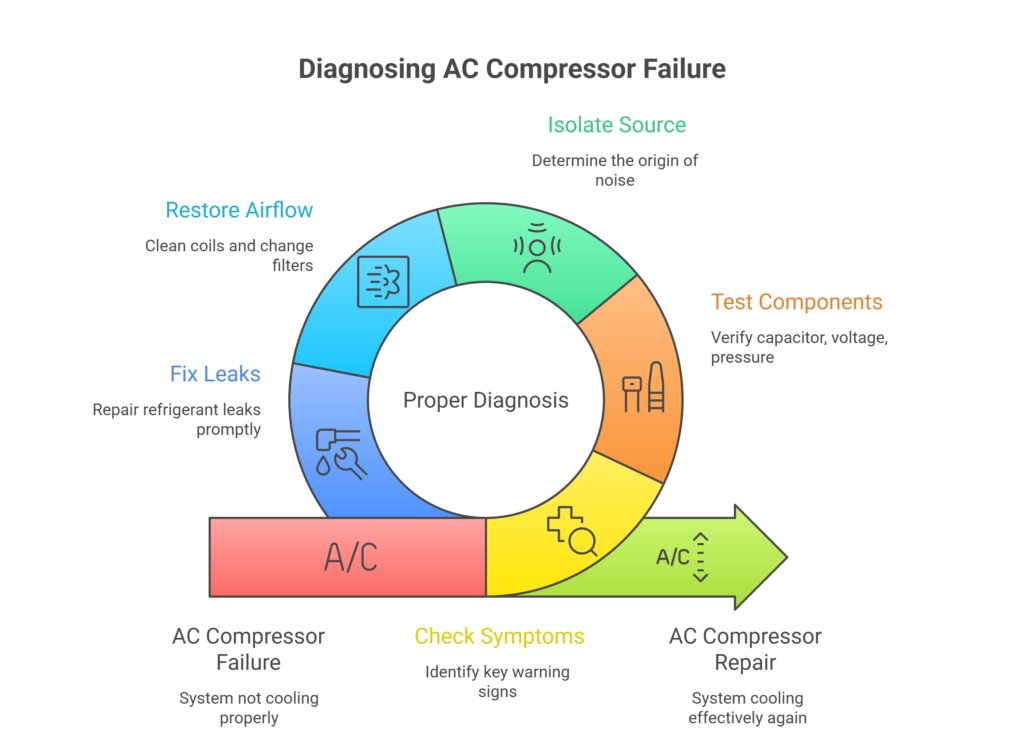
That is why we will break down the key symptoms, what usually causes them, and what the right fix tends to look like below:
Warm Air
If your AC is running but the air from the vents feels warm, the system is already losing cooling capacity.
Cause: Low refrigerant, a refrigerant leak, weak compression, dirty coils, or restricted airflow can all reduce heat transfer. Once suction pressure drops, the evaporator coil removes less heat from the air inside your home.
Fix: Check refrigerant pressure, airflow, and coil condition first. Fix any leak before adding refrigerant. Clean the coil if airflow or heat transfer is restricted. If the compressor cannot maintain normal pressure, replacement becomes more likely.
You may also notice the same warning signs discussed in AC is working but not cooling.
Hard Start
A hard start means the compressor does not enter the cycle cleanly. You hear the outdoor unit hum, hesitate, or struggle before it fully turns over. At that point, the motor is trying to start, but the system is fighting an extra load before stable operation begins.
Cause: A weak capacitor, low voltage, high head pressure, a locked rotor, or internal compressor wear can all create this symptom. In that moment, startup load rises and current draw spikes, so the motor has to fight harder to enter a stable cycle.
Fix: We would start with the start circuit first. Test the capacitor. Check incoming voltage. Measure startup current and compressor amp draw. If the numbers point to a weak start component, the repair may stay on the electrical side. If the compressor is locked, over-amping, or still struggling with proper voltage and a good capacitor, the fault is usually deeper than the start components.
Loud Noise
Loud noise becomes more concerning when it changes with load. The outdoor unit may rattle at startup, squeal while running, or bang when the compressor tries to engage. That pattern usually tells us the sound is tied to movement, pressure change, or internal strain.
Cause: The sound may come from worn compressor parts, loose mounts, fan imbalance, or electrical chatter. If it gets worse during startup or under load, compressor strain becomes more likely.
Fix: We would isolate the source first, not guess from the sound alone. Check the cabinet, fan section, mounting points, and compressor shell separately. Tighten loose hardware where needed.
Replace worn fan parts if the noise stays on that side. If the sound follows compressor engagement and gets worse under load, the problem usually points to mechanical wear inside the compressor.
Short Cycling
Short cycling means the system never stays on long enough to reach a stable operating pressure. Each restart puts the compressor under fresh electrical and thermal load, so cooling performance drops while wear builds faster.
Cause: Low refrigerant, thermostat faults, clogged filters, restricted evaporator airflow, control-board issues, or rising compressor stress can all trigger this pattern. Pressure conditions stay unstable, motor temperature climbs, and contactors or capacitors can wear out sooner than they should.
Fix: Start with the control side and airflow side first. Check thermostat operation, filter condition, blower performance, and evaporator airflow. Then verify refrigerant readings and pressure behaviour across the cycle. If those areas test normal, the next step is to assess compressor performance under load.
Also Read how often should you service your air conditioner.
Breaker Trips
A breaker that keeps tripping is a protection signal, not a small nuisance. The unit is drawing more current than the circuit should carry.
Cause: Locked rotor current, overheated windings, high discharge pressure, capacitor failure, or another electrical fault can trip the breaker. In compressor cases, the motor pulls extra amperage because it is fighting heat, pressure, or internal damage.
Fix: Check current draw, capacitor condition, contactor health, wire terminations, and supply voltage. Correct any electrical fault first. Clean the condenser if the head pressure is too high. If the compressor still over-amps under normal conditions, the motor may be failing internally.
Ice or Leaks
Ice on the lines or oil around fittings often points to a refrigerant-side fault before it points to a dead compressor. Many homeowners miss that difference.
Cause: Low refrigerant, a small leak, dirty evaporator surfaces, or restricted airflow can push the coil temperature too low. Ice then forms. Low charge also reduces motor cooling and oil return, which adds compressor stress over time.
Fix: Find the leak. Repair it properly. Evacuate and recharge the system to specification. Restore airflow by changing filters or cleaning coils where needed.
If the compressor has run too long with a low charge, the final repair may still involve compressor damage. Seasonal preparation helps reduce that risk, including how to prepare your air conditioner for summer.
High Bills
A rising hydro bill with weaker cooling means the system is working harder for less result. That usually points to efficiency loss somewhere in the cycle.
Cause: Reduced compression efficiency, dirty condenser coils, poor heat rejection, refrigerant loss, or long runtimes can all drive bills up. The compressor keeps running, yet the system moves less heat per cycle.
Fix: Check condenser cleanliness, refrigerant charge, runtime pattern, and amp draw before assuming full compressor failure. Clean the outdoor coil if heat rejection is poor. Correct charge if readings confirm a refrigerant problem.
If the compressor is inefficient under normal conditions, further repair or replacement becomes more likely. Better upkeep often prevents this path, which is why HVAC maintenance in Mississauga matters.
Wrong Diagnosis
Not every no-cooling call means the compressor is bad. Several AC faults can imitate compressor trouble closely.
Cause: A weak capacitor, thermostat issue, low refrigerant condition, dirty coil, or airflow restriction can all produce warm air, delayed starts, short cycling, and poor performance. Those overlap with common bad AC compressor symptoms.
Fix: Diagnose before replacing parts. Check pressure, temperature split, capacitor value, airflow, and electrical load first. Then judge compressor health from real readings, not from one symptom. That is also why many homeowners compare compressor trouble with capacitor trouble when the outdoor unit struggles to start.
This is the right way to assess causes of AC compressor failure and choose the proper AC compressor fixes. Start with the symptom, connect it to the most likely fault, and then confirm the repair with proper testing.
That process leads to a cleaner diagnosis, a more accurate repair plan, and a better chance of stopping a smaller issue before it grows into a costly compressor problem.
As you can see, compressor problems do not come from one simple cause, and the fix depends on what testing finds. But the next question is usually the same: what will this actually cost? Let’s move into AC compressor replacement cost in Canada.
What is The AC Compressor Replacement Cost in Canada
If you are here, you probably want the number first. Fair enough. The AC compressor replacement cost in Canada usually lands in one of two lanes: about $800 to $1,600 CAD under warranty and about $1,700 to $3,300 CAD out of warranty.
From there, the price moves up or down based on labour, refrigerant work, system age, and the condition of the rest of the AC. In other words, the compressor price matters, but the full repair scope matters just as much.
| Cost factor | What it usually means for your quote |
| Typical Canadian range | A warranty-covered job is often $800–$1,600 CAD. An out-of-warranty job is often $1,700–$3,300 CAD. |
| Parts cost | The compressor itself is usually the biggest single part cost. Once the warranty is gone, the total rises fast. |
| Compressor labour cost | This job is not a quick swap. The system often needs diagnosis, refrigerant recovery, installation work, evacuation, and testing before it can go back into service. |
| Refrigerant-related add-ons | If the system needs refrigerant recovery, leak checks, a filter-drier, evacuation, or recharge, the final price can move well above the base compressor cost. |
| Warranty vs no warranty | Warranty can change the whole decision. If the compressor is covered, you may mainly be paying for labour. If it is not covered, you are paying for both the part and the labour. |
| System age | If your AC is already 10 to 15 years old, compressor replacement starts looking less attractive because other major parts may also be nearing the end of their life. |
| System condition | Dirty coils, weak airflow, refrigerant leaks, electrical faults, or a contaminated circuit can widen the repair scope and increase the total. |
| Repair vs replacement decision | If the unit is newer and under warranty, compressor replacement often makes more sense. If it is older, out of warranty, and already showing other issues, full replacement may be the better value. |
The real decision comes down to value. If your unit is newer and the compressor is still under warranty, repair often stays on the table.
If the system is older, out of warranty, and already fighting other issues, the quote can start getting too close to replacement money.
Final Thoughts on AC Compressor Failure
AC Compressor Failure is a serious issue, but it should never be diagnosed by guesswork.
Warm air, loud noise, short cycling, and repeated breaker trips can all point to compressor trouble, but those same signs can also come from refrigerant loss, airflow restriction, or electrical faults elsewhere in the system.
That is why the next step is a proper inspection, not a fast assumption.
If your AC is blowing warm air, making unusual noise, or struggling to stay on, it is best to have the system checked before the damage spreads and the repair cost climbs.
If you are trying to plan the next step, you can also review how to choose an HVAC company before booking service.

